
lighting shadows
The Woman of Afghanistan
Jamila, Afghanistan
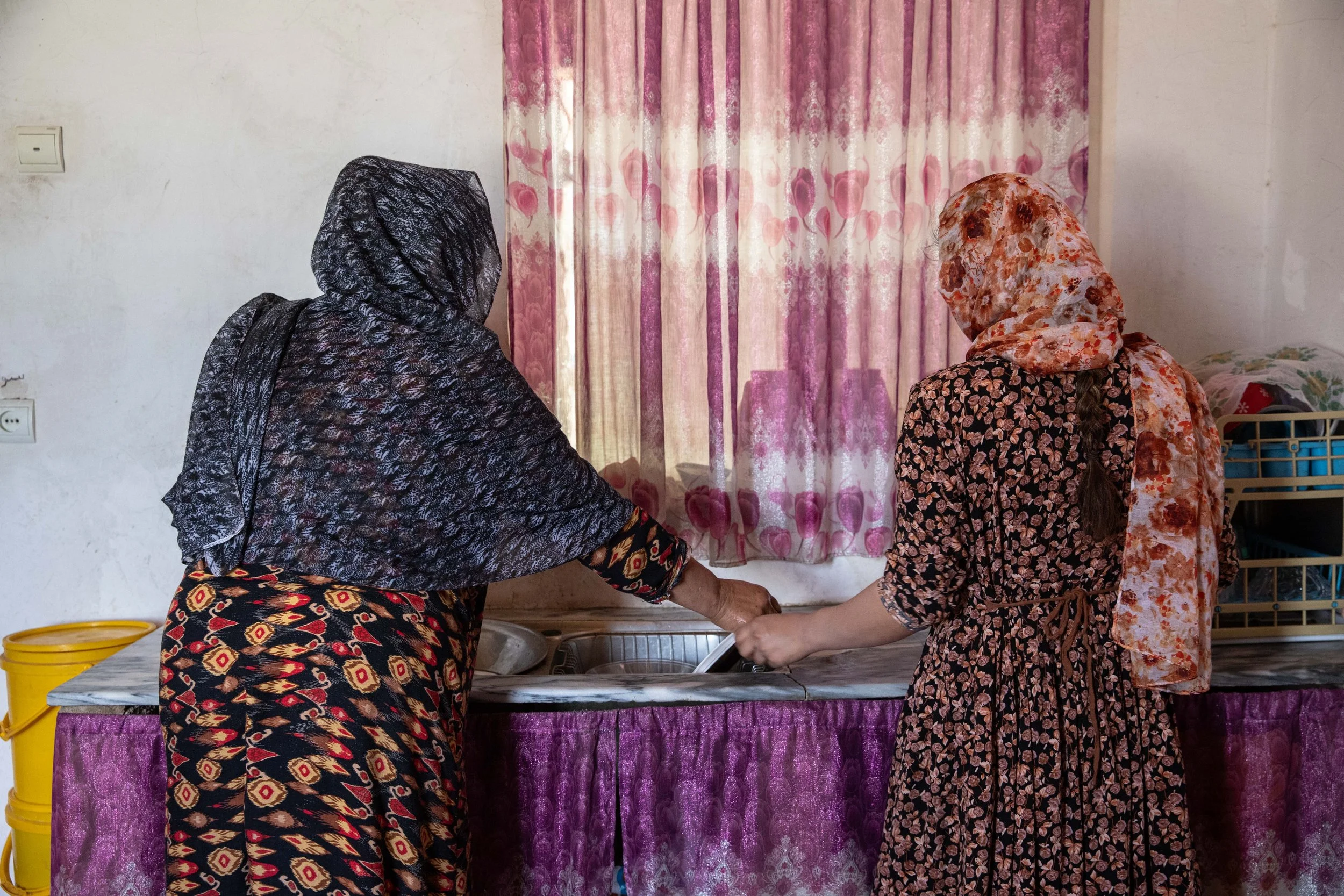
I am a teacher at a school in a large city. I am currently living under very difficult conditions. Our life used to be ordinary—not luxurious, but ordinary. Since the Taliban came, they have brought changes not only to our lives but to the lives of all people. We are all, in different ways, hamstrung now. Girls cannot go to school, they cannot learn, they do not have freedom, and their lives do not unfold as they would like. They are not even allowed to leave the house when they want or dress as they want.
When we do leave the house, we have to make sure we have everything the Taliban demands from us. It is a difficult life. We are not happy with our current situation. Economically, if I am honest, not only we but almost all people are unemployed and without means of subsistence. Our mothers and our children are housebound. Our daughters do not go to school, and they do not have freedom. There are so many problems that the more quickly I mention them, the better.
I would like to tell a story from my life before the Taliban came to power. Years before they took over, we had a very good life. I was a teacher in a kindergarten in the province of Aab and Bareq in the east. My family and I were content. I had no serious worries. My daughter went to school, and my son and I were very happy. We had a car, which we used to go to work, to the market, and for other needs.
Then the Taliban took power, and they immediately began to impose their rules. They forbade women from working and going to school. They imposed a strict dress code on men, requiring them to wear a beard and specific clothing. It was a very oppressive and unjust regime, and it was clear that the Taliban were not interested in the well-being of the people.
One day, I was walking through the market when I saw a man wearing a traditional Pashto turban. He was shouting at a woman, questioning why she was wearing a burqa and why she was dressed in a certain way. It was strange because the burqa is a traditional dress for women in Afghanistan. Yet he mocked her hijab and her clothing as if she had done something wrong. The scene was very disturbing.
I was upset and decided to speak. I approached the man and asked why he was shouting at her. He said he was a Taliban commander and that he had been ordered to enforce the dress code. I told him I was a teacher and that, under the new regime, I was no longer allowed to work. I explained that I could not provide for my family. He became very angry and threatened to arrest me. I was terrified and ran away. After that, I felt shaken and powerless—I felt that the Taliban were destroying our lives, our happiness, and our culture.
This is just one story from my life, but it represents the experiences of many people in Afghanistan under the Taliban. It is a story of oppression, injustice, and fear. It shows how they destroyed the lives of ordinary people and imposed their rules on all of us. I still remember the man turning away at the end and saying, “I don’t want to see you again. I don’t want to see you wearing a burqa.”
We faced many problems because our daughters could not go to school, and many schools were closed. At that time, it was not like now, when some girls can study at least up to sixth grade. Back then, there was nothing. We were all housebound, surrounded by oppression and injustice. People were very poor and struggling to survive.
After the Taliban were defeated and a democratic government was established, we returned to work, and our lives improved. Our daughters went to school, and we lived better. We had work, and we had enough to live on. But when the Taliban returned, our lives changed again.
Economically, not only we but the majority of the people in Afghanistan have been affected. Most people are poor and struggling to survive. It is especially difficult for women, who are often unemployed and unable to provide for themselves. This situation is very painful. When our daughters are not able to go to school, they are not able to work, and they cannot support themselves. They constantly worry about their future and cannot pursue their dreams. Their mental state is very poor; they suffer all the time. They cannot go outside freely or pursue their education. They cannot work and cannot build independent lives. This is very hard for us, and we struggle to help them.
Our only hope is that the international community will pay attention to the plight of Afghan women. We want the world to recognize our situation and help us escape this misery and suffering.
Before the Taliban came to power, we were able to go to school in a normal way. Our daughters, from first grade to twelfth grade, were eager to study. Our teachers were dedicated and taught us effectively. We were not divided by gender, and we all learned together. We were happy and content, and our lives were good.
When we were in school, our students were full of enthusiasm. But when the democratic government was overthrown, everything changed. We were no longer able to go to school, and our daughters were forced to stay at home. It was a difficult and painful time. Then, for a short period, we received news that our daughters would be allowed to return to school. We were called and told that classes would reopen, and we were filled with hope. But after a few days, the schools were closed again, and our daughters were sent back home. The disappointment was heavy, and we were deeply upset.
Our only hope, again and again, is that the international community will listen to the voices of Afghan women and help us escape this suffering.
Since the Taliban came to power, many of our teachers have left the country, and many students have also gone. Our relationships with others have changed. We were told that the principal of the school must be a woman because the school is co-educational. At the same time, we were told that our exams and tests would be conducted by men, and the questions were often strange and inappropriate. They would ask things like, “What is your name?” or “Do you pray?”—questions that belonged more to interrogation than education.
This division between men and women is painful. We are Muslims and we believe in our values and principles, but the Taliban have imposed their own harsh rules and made life difficult. They have also created divisions between different groups, such as between Dari and Pashto speakers. Before, we did not have such problems; we lived like brothers and sisters, in relative harmony. Now, they sow division and conflict, and we can no longer live in peace.
The restrictions on women have increased a lot. In the beginning, when we went to school under this regime, there was no peace or sense of safety. We went with fear and trembling, even from home to school. The stress was constant. At school, everything had changed. The knowledge and experience of the older, more qualified teachers were no longer valued. Instead, those teachers were insulted and spoken to cruelly.These are the same teachers who helped produce doctors, engineers, and even presidents. Yet the Taliban do not even pay their salaries on time.
Before the Taliban, during the Republic, it was required that all civil servants, especially teachers, have a bachelor’s degree. Despite the poor economy, many teachers, even at an older age, forced themselves to attend university. They faced many difficulties, including the quarantine during the pandemic, in order to complete their studies.Then the Taliban came and took away the additional 2,000 Afghanis that had been added to teachers’ salaries for having a bachelor’s degree. Even the food allowance given for lunch was reduced for women. Women received 30 Afghanis while men received 40. In the Taliban’s eyes, a woman should not leave the house at all. A woman who goes outside is considered a non-believer, and women who work outside are treated with contempt. They do not even acknowledge women as part of the workforce.
Before the Taliban came again, we used to go to school with great enthusiasm and interest—not just us teachers but also our students. Now, they have taken everything from us. When a teacher enters the classroom, she should be at peace both economically and mentally. She should be able to focus on the lesson and the students, not worry about what her children will eat for lunch or dinner. This life is very difficult for a teacher, yet these concerns are never considered. Instead, they have taken everything from the people—their lives, their work, their businesses. All government departments are in a state of paralysis and collapse.
We also face a great shortage of doctors. In Afghanistan, there are not enough qualified midwives, not enough proper doctors. Anyone with a little knowledge is appointed as a doctor, regardless of their actual skills. This is a great betrayal, playing with people’s destinies. We always pray that God will make these days end soon. We hope that a regime will come that truly values women.
The restrictions and changes continue. In the past, before the Taliban, we worked alongside men without any problem. We were like brothers and sisters, like family. When they came, they began to insult women to the point that we were not even allowed to greet male teachers. Our working hours were separated so that when women were on break, men were not, and vice versa, just to prevent us from seeing each other. Women were no longer allowed to enter many educational spaces. When we approach the school gate now, whoever is there speaks to us in a harsh tone: “What are you doing? What is your business here? Don’t go in. We will take the papers ourselves.”
At school, we are constantly being told, “Hurry up, the Amr bil Ma‘roof is coming, put on your veils and masks.” They have turned women into something powerless. A woman has no rights in this society. Even if everything is calm at home, when we come back from outside, we bring those problems and worries with us. And we worry about what will happen next.
My greatest worry is for our children, especially our daughters. They are deprived of freedom and education; they are deprived of the right to live fully. Our reaction is often silence. We become discouraged and emotional. The Taliban do not listen to anyone, and they do not care whether a woman is young or an academic. In the past, when we left school and went home, everyone respected us because we were teachers. Now, being a teacher means nothing. When we enter the school and see the Taliban, we are filled with fear. We do not dare raise our voices, because women’s voices are considered forbidden.
This is our daily life. In the city and in the market, we face constant humiliation and insults, and no one hears our voices. A woman has no right to wear what she wants, no right to go where she wants. Even in a car, she is not supposed to raise her voice or answer her phone.
There have been many incidents that I have personally witnessed. One day, in the market on the way to the airport, I saw a woman being insulted and humiliated by the Taliban. They said many ugly things to her. She screamed and cried, asking, “What is my crime? Tell me!” They simply said, “Why did you come out without a male guardian (mahram)?” People gathered around, but no one could do anything. The Taliban took her away.
Another time when I was going to my brother’s house, I saw a young woman wearing a proper Islamic hijab. She was stopped simply because she was wearing jeans. They beat her, insulted her, and said vile things that are hard even to repeat.
One of my coworkers, a kind and respectful young woman from Herat, told me her story. She went with her husband to see a doctor. She was standing on one side of the street when officers from the Ministry for the Promotion of Virtue approached. Her eyes are naturally a beautiful blue. They began insulting her husband, accusing him of letting his wife wear lenses. Her husband asked, “Why? What have we done wrong?” They said, “Why did you put lenses in your wife’s eyes? Are you even a Muslim? Are you even human?” She kept pleading, “Mullah sahib, my eyes are naturally this color,” but he refused to believe her. He even accused her of having artificial eyelashes in addition to lenses, as if that were a crime.
I also face daily problems just going to the market. We live in a remote area, which is crowded and far from the city center. When we go into the city, especially when we try to get into a car, the insults and humiliation seem endless. Our economy is so weak that even paying one fare is difficult, but we are often forced to pay twice for the same route just to reach the main road. When we ride up to the top of the hill, the first question they ask is, “Do you have a mahram?” If we get into a city car afterward, no one listens to our concerns. They demand extra money. If a woman is alone in a seat, the Taliban will not allow it. If a man sits in front of us, they ask, “Where is your mahram?”
Our mahrams are not idle; they cannot be with us everywhere we go. We cannot send our daughters anywhere alone. Young women cannot go out by themselves. The Taliban do not care whether a woman is young or middle-aged; they treat all women the same—with disrespect. This is our reality.
Even with taxi drivers, there are arguments about playing music. No one can listen to music freely. They say women and girls should not have smartphones. Not just at work, but everywhere, they tell us women can only use simple phones, not smartphones.
We live far from the city, but when we run after the cars, we are told, “No, no, women aren’t allowed,” and they only pick up men. By that time, it is often evening, and this is very discouraging for us as women. The security situation is not good. We wander from street to street chasing cars, hoping someone will allow us to board. Sometimes we find a ride, but they say they are only going halfway, to our area.
Even when we are allowed to board, they charge us double fare; otherwise, we cannot ride at all. In those moments, life feels bitter. A poor woman has no worth in Afghanistan. For women, once it gets dark, everything becomes more dangerous, and no one considers our situation. We are middle-aged, but I also think of the young girls—stranded, running after cars. Sometimes the driver says he will not go all the way to our area, then takes half the fare, later loads more passengers, and decides to go there after all, forcing those already in the car to pay extra. Seeing all this hurts our morale.
On the road, my mind is filled with thoughts of how much women are insulted and humiliated in this country. No one hears our voices. Young girls are beaten on the streets, insulted, humiliated, even killed, and there is no one to listen to them. In the mosques, when the mullahs say that a woman’s voice is awrah (shameful) and should not be heard, it breaks us emotionally.
Women are given no importance. A woman is a mother, a sister, a daughter. She is the one who builds families and society, who helps build a nation. But under the Taliban, a woman has no value. She is treated as if she were nothing.
I am a mother myself, and a mother always dreams that her children will achieve something in life. I have five daughters. Three are married, and two live with me. My daughters went to university, but now they are unemployed and sitting at home. When I look at them, I do not let them lose hope. I give them books to read or encourage them to watch something useful on the phone or television, something from which they can learn. If there is an entertainment program, I try to create something similar at home for them. I organize small programs so they do not feel crushed by boredom and sadness, because it is hard—they are not allowed outside, and inside they have very little.
I have a message for all mothers: dear mothers, maybe not all of us need to work outside right now because the world outside is dangerous. But we should not tell our children to sit in despair. We should not lose hope to that extent. We must trust in God—God is merciful.
We never lose hope in God; we always have faith. Life comes with its struggles, but we must never give up. We should never be negative; we must always think positively. When we face difficulties, we mothers must be a shield at home for our children. We keep trying, we keep encouraging.
When our children are working, or when our sons are employed or studying at university, it gives us strength. It shows that we are standing on our own feet. We never give up, no matter what we face—as mothers, as women, as sisters—we do not surrender. In our family, my husband always encourages us and says, “These days will pass. Never lose hope. Never give up.” My brothers also support and encourage us. With these hopes and dreams, we continue to move forward in life.
Restrictions have always been many, but we try not to give up. Life has its ups and downs, and maybe this phase will also pass. We should not think that life is over just because this situation has arisen. Even young boys seem depressed and sad; no one feels true joy in their hearts. But still, for the future, we encourage ourselves and others. They say every darkness is followed by light and every winter is followed by spring. In the same way, we give hope to our children: never give up.
Having no obstacles in Afghanistan is impossible; maybe their shapes change, but obstacles always exist. Still, we fight. We never give up, because we think about our future and the future of our children. We fight, we work, and we struggle as much as we can.
On behalf of all the women of Afghanistan, what I want from the international community and the world is that they pay attention to Afghan women, because whenever we try to raise our voices, we are silenced. Let the international community hear our voices, because we have so many problems. An Afghan woman cannot live comfortably, not even in her own home. She does not have the right to education or the right to work. An Afghan woman has almost no rights at all. All I want is for my voice to be heard.
Our daughters should not be forced into marriage at a young age. They should be allowed to pursue their education and choose their own path in life. They should be able to contribute to their families and communities, and they should be treated with respect and dignity.
Samar, Afghanistan
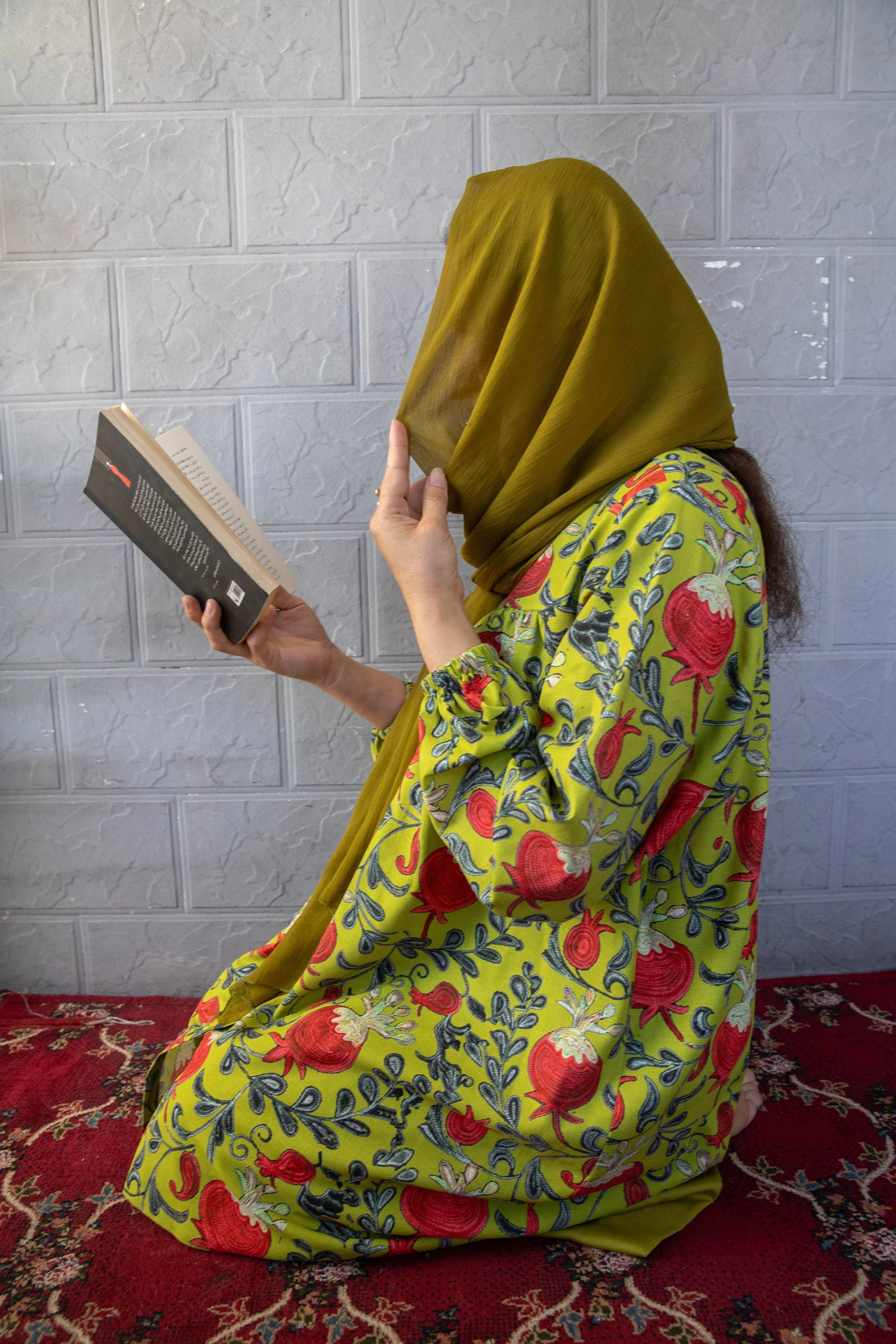
When I have free time, I read. I especially love novels because I dream of becoming a writer. I am also interested in psychology, and these are the two fields I study the most. Writing and reading help me survive the heaviness of my days. My favorite colors are white, gray, and pale yellow. White holds many memories for me. When I was in school, white surrounded my life—our clothes, our dreams, our hopes. I was attached to it deeply, and I still wish to wear white again and return to school with that same beautiful color. Yellow, to me, represents friendship, and gray feels calm and meaningful.
The fall of the government changed everything. Even now, it is difficult for me to put those feelings into words. Some places are so dear to the heart that remembering them becomes painful.
At that time, my siblings and I were living in a shelter. We were strangers there, hungry and uncertain; my uncle had brought us. We were four sisters and two brothers. As the Taliban advanced, older girls were in danger, so my uncle transferred us to a shelter in another city along with other children. My eldest sister, who had already graduated, was in Kabul.
The day after we arrived in the city, the shelter director told us not to be afraid. During the night, our district had fallen, and the city where we were sheltering had surrendered without resistance. My heart sank. We were told that anyone who had a home could leave, and those without one could stay. Without my older sister and without money, we had nowhere to go, so we stayed.
One day, while watching television with my sisters, we heard the news of the fall of Kabul. The pain was unbearable. It felt like losing a loved one. That same pain brought back memories of my childhood—the day my mother died, the suffering, the fear, the loneliness. It all returned at once.
Life in the shelter was isolated from the outside world, but the caretakers tried to keep our spirits alive. They encouraged us to study, even when school itself was no longer there. Later, when the new year came, we were transferred back to our district. Still, there was no real school. Some Taliban supported girls’ education, others opposed it. For a short time, the district governor allowed us to attend school, but the hope we once had was gone. None of us had the same motivation. Our conversations were filled with fear and uncertainty. When the mind and heart are restless, peace is impossible.
After the district governor changed, schools closed again. We continued studying in the dormitory, but it was not the same. School has its own place in a person’s heart. Nothing can replace it. I miss it deeply, more than I can express.
My life before coming to the shelter was even harder. We were very young. My two brothers were still babies. My mother had cancer, though we did not know it at the time. My father was a shepherd and was often away. One night, after a traumatic experience in the mountains, he suffered a mental breakdown and later went to Iran for treatment.
My mother became very ill. Our village was remote, with little access to transportation. Neighbors helped carry her to the hospital at night. By morning, she was gone. I still remember fragments of her—her hands, her strength, her courage. When she died, my eldest sister was only sixteen, and the rest of us were children. My uncle later came from Iran and brought us to the shelter. My father remained in Iran, and for a long time we did not even know whether he was alive. No one asked about us. The beginning was unbearably hard, but over time, we learned how to endure.
Life during the Republic was full of routine and hope. We woke up early, prayed, exercised, attended classes at school, and drank tea. In the afternoons, we ate together, studied again, and played volleyball in the evenings. We did our homework at night and watched television. We met people, learned, dreamed, and lived with enthusiasm.
After the Taliban came, all of that disappeared. There was no school, no sports, no freedom. We were forced to wear long clothing, tents, and masks. Even in the heat, we had to cover ourselves completely. It was suffocating and joyless.
Society changed as well. On television, women disappeared or were forced to cover their faces. Many presenters left the country. Programs lost their beauty and meaning. In society, many men adopted the belief that girls should marry at thirteen. They ignore the fact that a child cannot carry the weight of a family or life’s responsibilities. This mentality is cruel and irrational. My father never believed this. Though he is illiterate, he understands the value of education through his own hardships. He always encouraged us to study. I respect him deeply and pray for his long life.
Now, many men look at women with contempt. This breaks my heart. Among my classmates, motivation disappeared. We all lost our spirit.
Despite everything, I try to survive. Every day, I read, study, and write. Writing about the beauty of life keeps me alive, even when beauty feels distant. I fill blank pages with hope. When I miss my older sister, I call her using the shelter manager’s phone. Talking to her eases my pain, even though she cannot change our situation. I stay busy with my sisters so the days feel lighter.
My dream is simple. I want the doors of schools to open. I want to study, take exams, go to university, choose my field, and become independent. It is devastating to have dreams while the path to them is blocked. I only wish the doors would open so we could move forward.
If my voice could reach the world, I would ask people to truly look around them. To see Afghanistan. To see Afghan women. Our lives are passing by while we wait to be heard. Life is not only eating and sleeping. Life is not just reproduction. Life is freedom, growth, beauty, and flight. We ask the world to see us, to understand kindness and humanity, and to listen
Sajida, Afghanistan
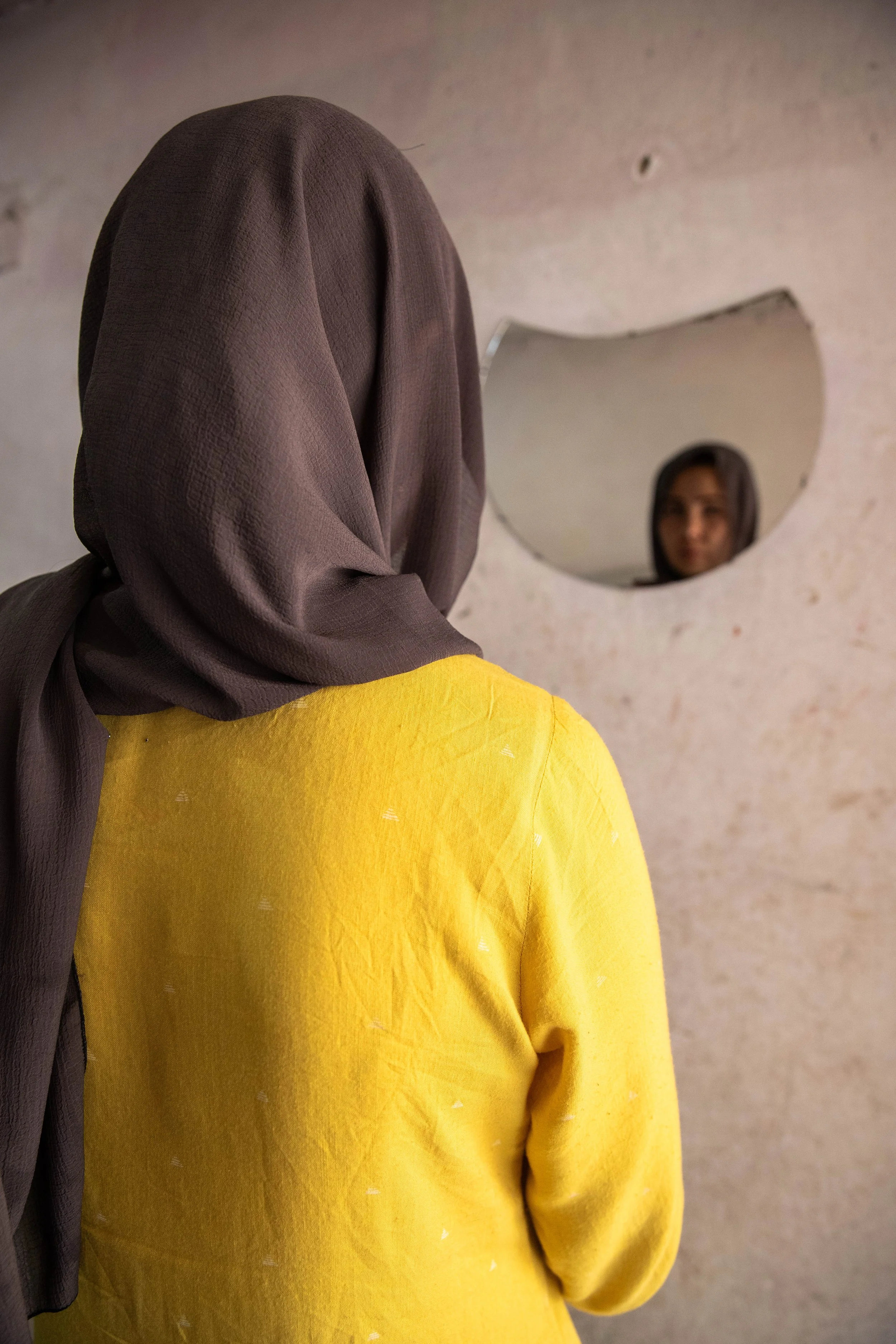
Most days, I stay busy reading my schoolbooks and keeping a journal. I record how my days pass and how my feelings change, because writing helps me understand myself. My favorite color is black. To me, black symbolizes power and honesty, and I associate it with sincerity, trustworthiness, and dignity.
The day the Republic fell in 2021 is a moment I will never forget. It was around noon. I was at home with my family, watching Tolo News on the TV. A reporter named Fawad Aman announced that the government had collapsed and that Ashraf Ghani had fled. At the same time, footage appeared showing the Taliban entering the Arg. I watched the three-colored Afghan flag being taken down and replaced with the white flag. That was presented as the first day of their rule, and it felt like the world I knew was being erased right before my eyes.
That year, I was in 12th grade, and the news hit me hard. I felt as if I had lost the most valuable thing in my life, as if my mother had left me and I had been abandoned. Fear spread through our home immediately. For years, we had heard stories about the Taliban: that they would shut down schools, strip women of their rights, prevent girls from working, restrict their movement, and control women’s clothing. Those stories returned all at once, and the future that had once felt open suddenly felt sealed.
One day after the fall of Kabul, the Taliban arrived in my district. People in the area went out to receive them. I climbed a hill near our house and watched from above as cars moved toward them, one after another. I saw how the community welcomed them, not because people were truly free to choose, but because there was no power to resist. After a while, the Taliban vehicles appeared, each with a white flag raised above it. Men sat inside with guns slung over their shoulders. The sight terrified me. In a local bazaar, a crowd gathered to greet them, and the entire scene felt heavy and forced, like a performance people had to act out in order to survive. I cried that day, not only from fear, but from sadness because I realized what was coming.
Not long after, the Taliban closed girls’ schools, and that decision broke me. We had studied for eleven years. We were finally in 12th grade, working toward graduation and preparing for the university entrance exam, the Kankor. Overnight, it felt like all our effort had been turned to dust. After we had completed the four-and-a-half-month exams, the Taliban shut the schools completely. The school administration gave out graduation certificates without conducting the final yearly exam, using marks based on the papers we had already taken. That is how I finished 12th grade—without celebration, without closure, and without the future we had been promised. Girls were no longer allowed to study, and even leaving the house became difficult and frightening.
The restrictions kept growing. Women were told they could not leave home without a male guardian, without full covering, and without a “necessary” reason. For those of us who had spent twelve years living with a sense of freedom—going to school, choosing our clothes without constant fear, moving around without being questioned—these rules felt like a cage closing around our bodies and minds. Even the simple act of breathing outside was stolen from us. These were not stories I heard about others; they became the reality of my daily life, and the reality for countless Afghan women.
Educational centers also closed, but after four or five months some courses reopened. Toward the end of 1401 (2022/2023), I went to a large city with my friends and enrolled in an English language center. Every day I attended class for one hour, following the Taliban’s dress code. On my way, I often saw officers from the Vice and Virtue department standing at intersections. They wore white clothing and carried weapons, and they watched people closely. Passersby were questioned, and every encounter felt like a warning. Sometimes, seeing them like that, I felt disbelief, as if the world had turned into something unreal. Still, whenever I saw girls walking with books in their hands, I felt a fragile kind of hope. Even with danger around us, they kept moving forward, as if education itself was a form of resistance.
During that period, as we were preparing for the entrance exam, an explosion struck the educational center. Thousands of lives were lost, and among the martyrs were two of my friends. The night before the explosion, I was in my friend’s room. The next day we were supposed to attend a seminar at the center but I went with my cousin to my uncle’s house instead, and I could not attend.
The next morning at 7 a.m., we were eating breakfast when my phone rang. A friend told me about the explosion. My mind rushed immediately to the people I knew who studied there. I called friends to ask if they were safe. At first, I did not even think of the two who were martyred because I believed they were not going to be there. Then my father called, worried, and asked me to stay at my uncle’s house. I could not bear waiting far from my friends, so I left around 7 o’clock.
The bus station was crowded, traffic heavy, and the air felt as though it was full of panic. On the way, I listened to people talking. Some were devastated, and some spoke as if nothing had happened, continuing their daily work as usual. I understood then that pain changes people differently, and that no one truly understands another person’s suffering until they have felt it themselves. About half an hour later, I arrived back at the room, and I barely remember the journey because my thoughts were scattered with fear.
When I entered, I saw my roommates crying. Their tears frightened me even more, and I kept hoping no one had died, telling myself that maybe someone had only been injured. The sound of ambulances did not stop. We stayed in fear until noon. Later, my roommate’s aunt called, and we went to her house. Near the end of an alley, both our phones rang, and we were told that one friend had been martyred. The news cut like a knife. The pain of losing a close friend and a classmate was too heavy for words. Near dinner time, we heard that another friend had also been martyred, and that second loss poured more grief onto our already sunken hearts.
After a few days, classes resumed, and we returned to our lessons, but we were not the same. We felt more afraid than ever. Each day we went to the course with the thought that we might not come back again. Two or three months after the tragedy, restrictions increased again, and girls were once more banned from attending educational centers. Eventually, we returned from the big city to our home district.
Before the Taliban came, life felt hopeful. Every morning I woke up with energy, preparing for school with excitement. I never wished to stay home, and I never felt tired of learning. I would clean my shoes, put on my white veil and uniform, and walk to school feeling as if I was moving closer to my dreams. I spent mornings in class with teachers and classmates, and after coming home I would rest briefly, then walk for an hour after lunch and go to a course. Life felt open and promising, without constant fear, and without restrictions pressing on every decision.
After the Taliban came, everything changed. The first thing they did was close the school gates, and that destroyed the rhythm of my days. I would still wake up as if I had somewhere to go, but then the reality returned: there was no path forward. The mornings became quiet and heavy, and instead of planning, we only waited.
After the courses closed and after the Taliban entered my home district, I lost the chance to take the entrance exam when I had planned. That year, the exam was held, but I was only studying English and I was not prepared. I had planned to take it the following year, but I never got the chance. After moving back from the big city, I stayed home for nearly a year. Sometimes my friends and I gathered at each other’s houses just to escape boredom and sadness for a few hours.
After a year, courses reopened in my district. My friend and I heard about public speaking classes at a local educational center, and we enrolled. Those lessons gave us a sense of life again. Our good teacher kept motivation, hope, and enthusiasm alive, reminding us that a path could continue even when it was narrowed. I attended public speaking for three months in winter while continuing English at the same time. After finishing the three-month program, I joined a six-month public speaking program with a professor. Now I participate in writing and English programs, and I hold onto them as a way to keep my mind active and my hope alive.
Even now, the Taliban’s restrictions still shape everything. When I go to class, I wear hijab, full covering, and a mask. Rules extend even to small details, and we are not allowed to wear short socks. Classes are separated completely: teachers teach girls in girls’ classes and boys in boys’ classes, and there are no mixed classes.
Before my writing class, I worked as a news anchor in a media agency. For about four months, we continued while observing Islamic hijab, and things felt manageable. Then one day, while we were in the studio—three girls working alongside five male colleagues—the situation changed. A curtain had been hung inside the studio so the women worked behind it and the men in front. That day I was recording a news program and reporting at the table when officials entered, and fear spread instantly through everyone.
They scolded us and questioned why we were working with men. They said it was forbidden for strangers to hear a woman’s voice. They accused us of working without a mahram and demanded to speak to my father. They called him to the studio and told him that in these circumstances, when girls were not allowed to work, he should not have allowed his daughter to work with non-mahram men. They forced him to sign a written commitment, and with that letter they shut down our work as women. They told us we had no right to work in any media outlet. The agency still operates now, but without a female announcer or presenter, and only under the condition that it publishes news approved by the Taliban.
That incident affected people around me to some extent, but my family’s behavior toward me did not change. They never blamed me, because I had done nothing wrong. My family remained supportive, as they always have. My friends, professors, and classmates also supported me. When I returned to courses after a few days, my professors encouraged me and reminded me that losing one path did not mean losing my entire life.
Still, the Taliban’s behavior toward women in the region remains painful and beyond what many people outside Afghanistan can imagine. Women are restricted from participating in gatherings, from appearing freely in society, and even from simple recreation. Girls are banned from community programs, and the space for women continues to shrink.
Over time, many people have been forced to get used to living with these pressures, but that does not mean we accept them. Each day that passes, I look for small ways to keep hope alive. Educational centers and courses have become a lifeline for us. Writing helps me survive. When I attend a writing class, I feel calm when I put my feelings and thoughts into words, and I feel as if I am moving one step closer to the person I want to become. Being with my friends also helps. We share both joys and worries, and even under these conditions, that companionship gives me strength.
My dreams are still alive, even though obstacles stand in front of them. Writing gives me a sense of purpose. Since 9th grade, I dreamed of becoming a journalist. I used to imagine myself behind a news desk, reading the headlines and saying, “Headline news with me, Asal.” The new rules have pushed my dream far away, but they have not erased it from my heart.
My message to the people of the world is that women have the right to live freely, to work freely, to move in whatever direction they want—without any obstacles or restrictions—and to lead their own lives. I want Afghan women to have their rights returned to them, and I want a future where a girl can study, work, and build her life without fear.
Rukhsar, Afghanistan
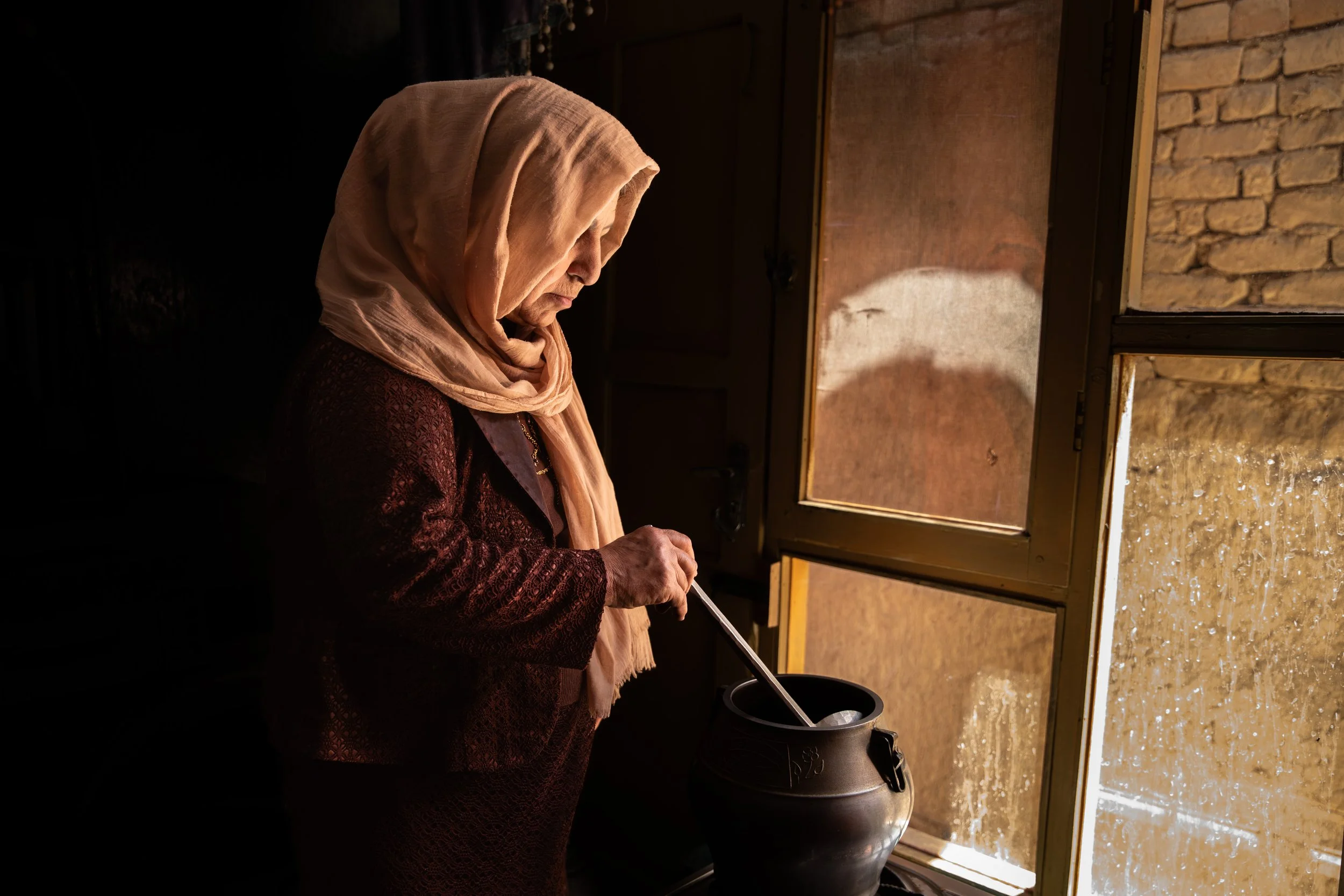
These days I stay at home without any specific occupation. I used to be a university student, but after the universities were shut down, I had no choice but to remain inside. In our family, there are two sisters, two brothers, and our parents. Most of my days are now spent doing house chores and helping around the home.
Black has always been my favorite color. I used to think it was because it matched everything, or maybe because it simply looked good. Before, wearing black made me feel confident. During school, our black uniforms and white scarves felt elegant, and I loved the way we looked. Now, black no longer feels like a choice. We are forced to wear it—long black coats, black scarves, black shoes. What once felt stylish now feels suffocating. My sisters and I used to love black, but now we all resent the kind of black clothing we are made to wear.
Before the Taliban returned, life was simple but full of meaning. I woke up early every morning, prepared my uniform and shoes, reviewed my lessons, and rushed off to school to meet my friends. School was not only a place of learning for me; it was a place of encouragement. We pushed each other to study harder and to dream bigger. I attended early morning prep classes, came home to study more, helped my mother, and waited for my father to return so we could have dinner together. It was a routine, but it gave my life purpose.
After the fall, everything changed. Fear took over our lives. For months, we did not leave the house at all. When classes eventually resumed, I returned, but I was never truly present. I could not concentrate. Fear followed me everywhere — the thought that the Taliban could walk in at any moment and shut everything down again was with me constantly. I had once been a good student, but stress slowly erased everything I had worked so hard to learn. Even at home, my thoughts never rested. I worried about losing the last remaining places where we were still allowed to learn, gather, and breathe.
That fear did not come out of nowhere. Our parents had warned us with stories from the past. We read about those times in schoolbooks. Every rumor, every news update, confirmed what we already feared—that women were not seen as human beings. Temporary closures became permanent bans, and over time the fear turned paralyzing.
I was in grade eleven when it happened. We had just finished our midterm exams. I had spent two years preparing for the Kankor exam, studying late into the night and pushing myself beyond my limits. Suddenly, all of it disappeared. I never even got the chance to say goodbye to my classmates or teachers. Something inside me broke. I had dreamed of studying medicine or computer science at a public university. When that became impossible, my parents noticed my mental state and encouraged me to enroll in a midwifery program, hoping it would give me something to hold on to. I tried, but eventually that institute was shut down as well.
I was no longer the same person. I had once been lively, spending time with friends, laughing, and enjoying being around people. After the Taliban returned, I barely spoke. I stopped seeing anyone. When guests visited our home, I stayed in my room with a book, speaking only when someone directly addressed me. My parents noticed this change and gently encouraged me to reconnect with people, even if it was only with a few girls in a class or course.
The friendships I once had slowly faded away. Many of my friends left the country. Now we are connected only through occasional messages or voice notes. Some moved to other provinces, others went abroad, and even those still nearby are trapped by fear and restrictions. We have not seen each other since that final year of school. Every time I heard that another friend had left, it felt like losing someone to death.
I often dreamed of leaving too, and I still do. It is not only about escaping, but about finding the parts of myself that were taken away. Education gave my life meaning. I wanted to make my family proud. I wanted to help others, especially those who could not afford medical treatment. That was why I turned to midwifery when all other paths were closed. I believed that at least I could still be useful. Now, without even that, it often feels as though I have nothing left to give.
The day Kabul fell, I was at home with my brother. My mother and sister were out taking an exam, which they were not allowed to finish. My brother ran inside and told me that Afghanistan had fallen. I could not believe it. My father, who worked for a government ministry, did not answer our calls for hours. Fear consumed us. When he finally called, he told us he had walked home from the airport road because there were no cars on the streets. He warned us not to expect to hear from him for a few days. For three days, we barely ate. We sat in silence, shocked and afraid. When my father finally returned home, it was the first moment I felt able to breathe again.
Months later, when I went outside for the first time, it felt as though I had entered a different country. The flag I loved was gone, and armed men filled the streets. Kabul no longer felt like home. Even my clothes made me anxious. I wore my mother’s old pants, and my grandmother whispered that if anyone saw me, they would sacrifice a bullet to save me. That sentence still echoes in my mind. I told my father about my fear, and after that day, I stopped going out for a long time.
Life at home changed as well. My brother lost his job and became withdrawn, staying in his room for days. My father was constantly exhausted, working endlessly just to keep our family afloat. My mother was worn down from teaching. We gathered only during meals, without laughter or real conversation, focused only on survival.
The most painful day of my life was when I lost my younger brother. He died in my older brother’s arms, leaving a wound that will never heal. Another deep scar came when a close friend disappeared, gone one day after school and never seen again. We still do not know whether she ran away or was murdered, and that uncertainty continues to haunt me.
Through all this, there have been moments of light, like the day my cousin was born. After all the darkness and silence, a new life arrived in our home. A baby’s cry. Laughter returned, even if only for a while. That day reminded me that joy can still exist, even in a broken place.
Hania, Afghanistan
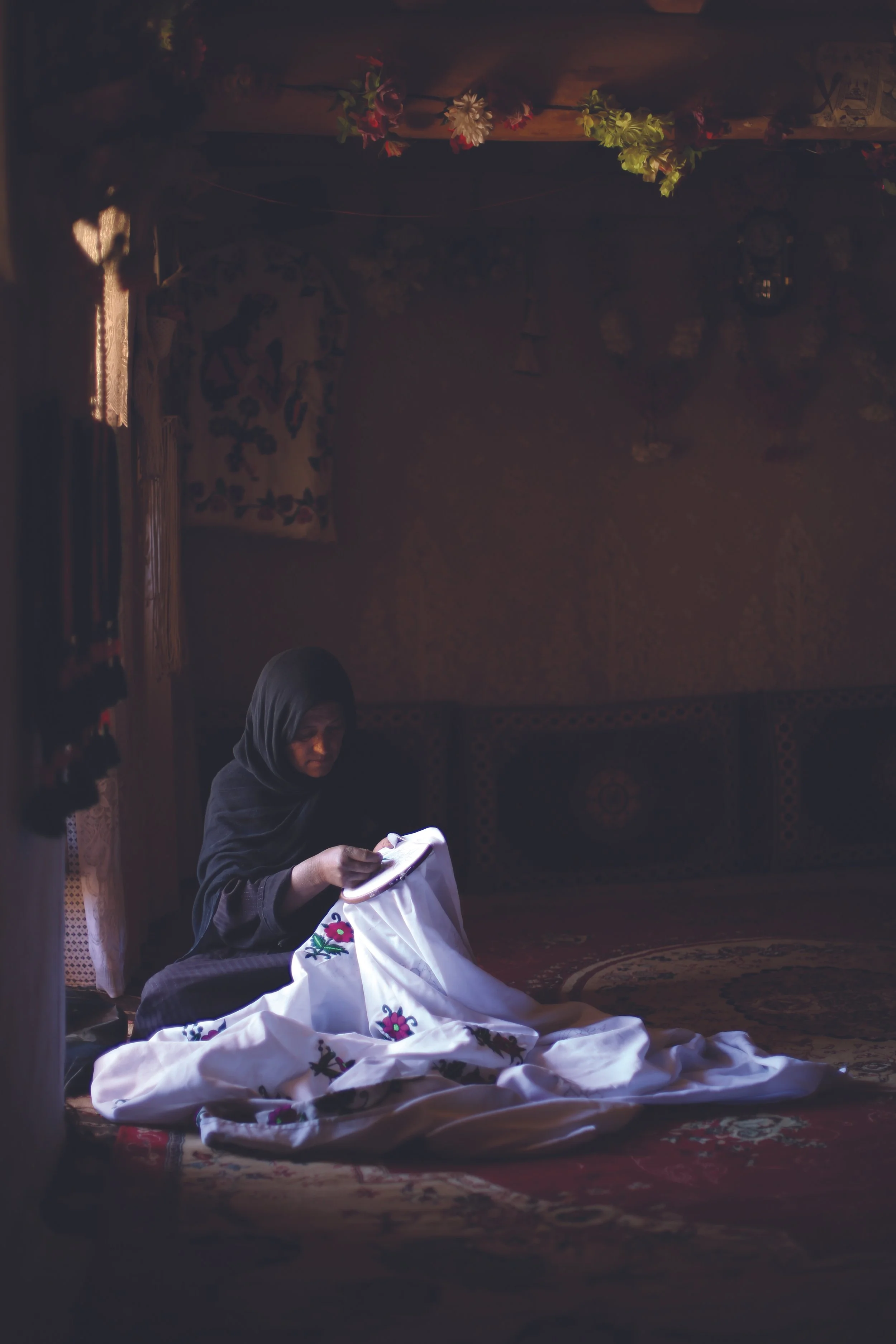
On the day the government fell, I was at home with my sisters. We learned from the television news that the government had collapsed and that the people of my district had gone out to welcome the Taliban. When I heard this, I was deeply surprised. I could not understand how people handed over their region to the Taliban without any resistance or defense. When my father decided to go to the bazaar to see them, I wanted to go with him. I was curious to know who these people were—those to whom our country had been surrendered so easily. My father did not allow me to go, so he went with my brother instead. When they returned, they showed me the photos they had taken. The men in the pictures were akhunds, wearing turbans and traditional Afghan clothing, with frightening faces. Seeing them made me feel deeply disappointed. I could not accept that a country full of educated and cultured people had fallen into the hands of such individuals. I felt ashamed and saddened by the way people welcomed the Taliban, and I thought to myself that our people had shown weakness by greeting their enemy instead of resisting. When my father spoke about the restrictions the Taliban were planning to impose, I did not feel fear. Instead, I felt anger and disbelief, thinking that if people truly wanted to, they could have stood against them. From that day on, my hatred toward the Taliban continued to grow.
Before the Taliban took control, life felt normal. We went to school every day, and after returning home in the afternoon, we studied and focused on improving ourselves and achieving our goals. Life changed completely with the arrival of the Taliban. The very first thing they did was close the doors of schools and universities to girls. From that moment, nothing felt normal anymore for Afghan girls. The path to our dreams was blocked. At that time, I was in the ninth grade and actively involved in social activities. I used to go to the library and read books, but soon many restrictions were imposed. Girls were no longer allowed to travel or go to the market without a mahram. Women were banned from working in offices and media.
After some time, when the situation became calmer, some educational centers reopened under strict conditions. Boys and girls had to study separately, and girls were required to follow the dress code defined by the Emirate. My sister and I enrolled in one of these educational centers. They explained the rules to us, and we began our studies again. Some girls attended with low motivation and broken spirits, while others tried to stay hopeful, believing that education could still lead them somewhere. Many girls, however, became depressed due to the restrictions and eventually stopped attending altogether. Even though we stayed in contact with them and encouraged them by explaining the benefits of continuing their studies, some families refused to allow their daughters to attend under such conditions.
The presence of the Taliban has also changed the behavior of men in our community, including my father and brother. Some men have adopted the Taliban mentality and have become stricter toward their families and wives. Others, like my father, sometimes support us, though at times he is influenced by the surrounding pressure. In society, there are men who are deeply disappointed by the Taliban’s treatment of women, and there are many conflicting viewpoints. The Taliban believe that women should remain hidden behind heavy veils and only value those who strictly follow their rules. Girls who appear with lighter clothing or smaller headscarves are not acceptable in their view. When Taliban members visited educational centers, they compared girls to white cloth that must be kept hidden to avoid damage. This mindset deeply affects men in society. Many people believe that the Taliban today are no different from the Taliban of twenty years ago—still opposed to women’s education and freedom.
To survive these difficult days, I stay close to my friends. We talk about the future and possible ways to overcome these challenges. I search for online educational opportunities and read books recommended by my teachers and friends. We try to keep each other’s spirits up—to give courage and hope to our friends, to stay strong, and to find a way forward in life. We give ourselves strength. Our families support us to some extent, and women in our community support one another emotionally. In my family, my mother understands our pain and encourages us, but many men whose mindsets have changed no longer offer support.
Before the fall of the government, the dream of every Afghan girl was to see her country progress and to achieve her personal goals. After the Taliban took power, many people gave up on their dreams. I dreamed of studying fine arts and becoming an actress. I wanted to portray the struggles of Afghan women through acting and tell the stories of those who could not speak for themselves. After the Taliban imposed their restrictions, I lost hope of studying my chosen field or becoming an actress. My father was not supportive of this dream and believed there were better professions than acting. Hearing this made me feel very discouraged. When there is no support from family or society, it becomes extremely difficult to move forward. But my sisters stood by me and reminded me that dreams can be achieved through determination and effort. Even with my father’s opposition, my brother encouraged me and told me that acting is also a meaningful field, one through which I could highlight the struggles of women and families in our society.
My message to the world is to support Afghan women and defend their rights against the Taliban. I dream of a day when Afghan women can work outside their homes, participate in media and government institutions, stand on their own feet, and live freely without restrictions—just like women in other countries. I also hope that future generations will not have to fight for education as we have, and that they will be able to change this country.
Sara,
Afghanistan
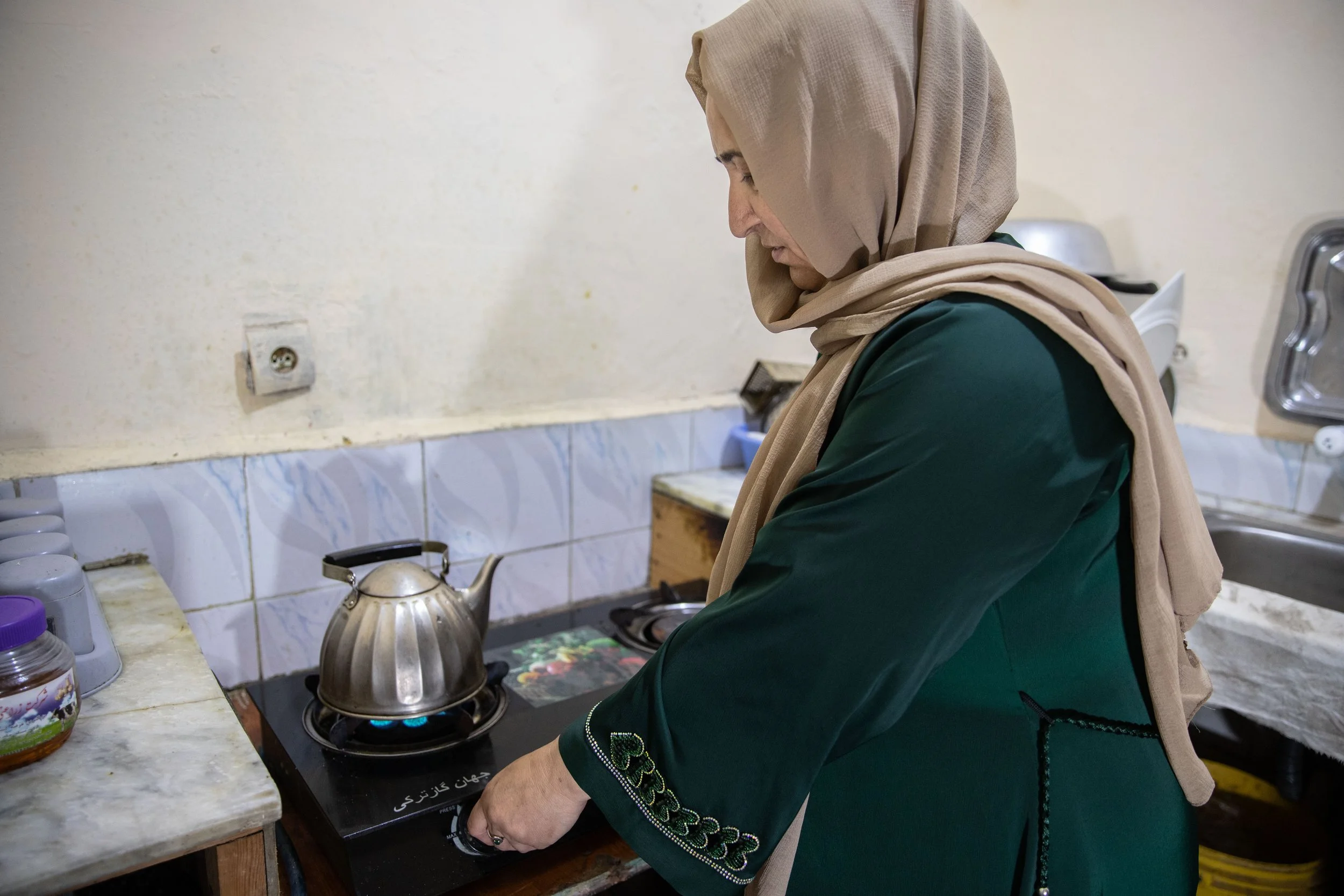
My name is Sara. I graduated with a bachelor’s degree in Dari literature. After finishing university, I worked for a year and a half as a teacher at a private school. Later, the school relocated to another area. The distance was long, the road exhausting, and the salary was so limited that most of it went toward transportation. Eventually, it no longer made sense for me to continue.
After that, I took the entrance exam for a commission. I passed and worked there for three years. When the Taliban came to power, everything shut down. All offices were closed, and women were no longer allowed to work. Since then, I have been unemployed, sitting at home. It has been almost three years now that I have been without work.
During the time of the Republic, I worked with great enthusiasm and motivation. Life felt normal. I could go to work without fear, without being disturbed on the road. Everything felt easier, safer. When the Taliban took over the provinces, I never imagined they would one day enter Kabul. Even though there were discussions at the office, I could not picture the capital falling or our lives stopping so suddenly.
On the day the Taliban entered Kabul, I was at home. News came from the office that everything was closed and that no one should come in until further notice. No one could predict what would happen next. A week later, we were told that women were no longer allowed to work. Our contracts had already ended, and we were waiting for new ones, so we stayed home. Our male colleagues continued going to the office, but for us, the doors were closed.
Before everything collapsed, my days were full of routine and meaning. I would wake up in the morning, pray, get ready, and go to work. When I arrived, the first person I usually saw was our supervisor, a kind and respectful man whose good character cannot be described in words. Our manager was a young woman, incredibly supportive and caring. Most of our coworkers were men; only fourteen of us were women, yet we worked together like a family. There was no tension, no division—just cooperation, conversation, and mutual respect.
When one of us faced a problem, we all helped. I remember one male colleague whose home in Logar province was completely destroyed by floods. His family survived, but everything they owned was lost. We collected money together to support him. He was supporting his family in the province while living in Kabul on a small salary, and his father was also battling cancer. These were the kinds of people we worked with. Those days were good—so good that no matter how much I speak about them, it will never be enough.
The narratives now being pushed—about separation, about danger—did not exist back then. Our manager used to hold regular meetings with the female staff. She asked each of us whether we felt safe, whether anyone had bothered us. She told us not to see her as a boss but as a sister, a friend, even a parent. She created an environment of trust, dignity, and openness.
At that time, I was independent. I stood on my own feet. I went to work with joy. Today, I am dependent on my family—on my mother, my brother—for money. I feel the weight of that dependence every day. There were days when I could go shopping freely, buy clothes, shoes, or a handbag without needing permission or explanation. Now, even if I see something I like, I ignore it. I do not mention it to anyone. Sometimes I avoid the market altogether because I know I cannot afford anything. Without income, even leaving the house feels pointless.
Before, I spent money on my friends. We went to restaurants when office food was bad. Sometimes I paid, sometimes we all contributed. Now, I barely know where my friends are. One got married, one stayed home, another left the country. Some disappeared completely. I do not know if they are alive, where they live, or what they are doing.
One of my closest coworkers used to commute with me every day. We waited for each other, called each other, walked together. Today, I have no news of her. Since the Taliban came, she vanished from my life. Not knowing where she is or whether she is safe is a pain that never leaves me.
I remember a time when three of us regularly went to a small restaurant near the office. We were not allowed to go far, so we went there quietly, laughing and talking. One day, a quiet coworker joined us without saying anything. She was the only working person in her family. Her father was sick. She never joined outings because she could not afford to spend money. Like many women, she hid her pain behind a smile. When I finally spoke to her privately, she shared her struggles. After that, we grew close. She once told me I was the only person she trusted at work. Today, I do not know where she is either.
The day the Taliban entered Kabul remains unforgettable. Fear consumed everything. I remembered the terrifying stories my mother used to tell about their previous rule—about violence against women. A week later, women were officially banned from work. Two of our coworkers tried to return to the office and found the doors closed to them while male staff were allowed inside. They told us how humiliating it felt to be locked out of a place where they had worked for years.
Since then, life outside the house has become frightening. Even when fully covered, even wearing a mask and long clothing, I have been questioned while simply waiting for transportation. I remember shaking, barely able to speak. The tone, the face, the authority—it all felt like an insult. It did not matter that I had done nothing wrong.
The treatment of women has changed completely. During the Republic, no one questioned our clothing, hair, or presence. Now, women are stopped in public, humiliated, shouted at. Even fully covered women are accused of being improper. This shapes how society looks at us. People assume a woman must have done something wrong if she is stopped. The burden always falls on the woman.
Today, my days are spent mostly at home. I wake up without hope. I pray. I stay inside. My only comfort is my nephew, the youngest member of our family. His smile helps me forget my pain, even if only for a moment. The restrictions grow every day. Those of us who studied suffer deeply, but my heart also breaks for the girls who never even had the chance to go to school.
I want a future where Afghan women are free. I want us to be seen as human beings—as living souls who deserve dignity, opportunity, and rights equal to men.
If the world is listening, this is what I want to say: See Afghan women as human beings.